Month: April 2019

WhatsApp reporting of women and child abuse videos: The common understanding versus the reality

By Dr.Debarati Halder

Image Source: WhatsApp

Couple of days ago my friend shared an alarming news with me on Facebook about WhatsApp. It says that several cyber security think tanks including Cyber Peace Foundation are now finding out how WhatsApp groups are circulating child sexual abuse videos and how these contents are growing viral.[1] This is not an uncommon incident now. In 2015 from Centre for Cyber Victim Counselling, we had done an empirical research titled “Harassment via WhatsApp in Urban and Rural India: A Baseline Survey Report (2015).[2] This research was conducted in three cities namely Tirunelveli, Kolkata and Delhi with responders from the age group of 19-40. Even though this research did not include survey on WhatsApp groups , but it did emphasize on personal harassment or receiving of the sexually explicit images, harassing videos of others etc. Some of the findings of this report are as follows:

  • 32.8% stated that they are aware of the safety tools in WhatsApp and 42.7% said they feel it is safer than other internet communication services. 41.2% stated that they were not aware of the safety tools and 13.7% stated that they don’t feel that WhatsApp is safer than other internet communication services. 1.5% did not want to tell about their knowledge of awareness regarding safety tools in WhatsApp and 11.5% did not want to tell about their feelings whether WhatsApp is safer than other internet communication services. 24.4% stated that they have heard about the safety tools in WhatsApp but have no direct knowledge about it. 32.1% stated that they have heard about other internet communication services, but they do not have direct knowledge, whether WhatsApp is safer because they do not use other services.
  • In answer to the question whether they had received any sexually explicit or obscene images including videos/images of rape, sexual abuse of women or children or men or LGBT people etc, among the 131 respondents, 11.5% stated that they had received sexually explicit or obscene images, 51.9% stated they did not receive such images and 2.3% did not want to answer. 34.4% stated that they are not aware of being targeted with such images because they do not use WhatsApp or have stopped using the services.[3]

This suggests that WhatsApp had been a “chosen platform” by predators since long.

 But why WhatsApp has become more dearer to predators than other social media websites like Facebook or Instagram especially for those including pedophiliacs or persons who  create and circulate abusive videos including sexual abuse videos of women  ?  Let’s have a reality check about WhatsApp here:

  • What is WhatsApp and how it works: As we had mentioned in the research report, WhatsApp messenger was started approximately in 2009 in the US by Jan Koumand Brian Action as a “better SMS alternative” (WhatsApp, 2014) and it is available for iPhone, Blackberry, Android, Windows phone, Nokia etc. This app uses the user’s phone number as the basic verification mode and it does not support calls via VoIP (Schrittwieser,Fr¨uhwirt, Kieseberg, Leithner, Mulazzani, Huber, & Weippl, 2014). Some of the basic features of WhatsApp include status update, profile picture update, uploading of address book (Schrittwieser, et. al., 2014), options to create/join groups (Terpstra, 2013), updates about location, uploading and circulating photos and videos and voice recordings. Typically WhatsApp verification may include a three stage procedure which involves (i) logging on to the download page of WhatsApp @ https://www.whatsapp.com/download/ and clicking on the chosen device icon and start downloading; (ii) the server then sends a 4-digit PIN number by SMS to the prospective user’s phone by SMS for verification and authentication (Schrittwieser, et. al., 2014), (iii) the user copies the code to the WhatsApp’s application graphical user interface (GUI) and after cross checking by the WhatsApp server the app gets activated on the phone of the user (Schrittwieser, et. al., 2014). Once connected with WhatsApp, the user can get the information about other WhatsApp users by simply checking his/her phone address book or call log history or Gmail address book. This is because WhatsApp may access the user’s contact list or address book to keep track of other mobile phone numbers who use the WhatsApp services and may store this information on the server (WhatsApp, 2014, see sub- para B in Para 3) to get people connected instantly, profile pictures of other users and one WhatsApp user may get instantly connected to others through the server.[4]
  • How do users create network on WhatsApp and how the groups may be busted?

After downloading the app and activating the same, the user may get connected to his friends or likeminded people by doing a simple search in his phone address book. Other numbers with WhatsApp applications may show up. Users may choose to circulate their messages in several ways through WhatsApp :

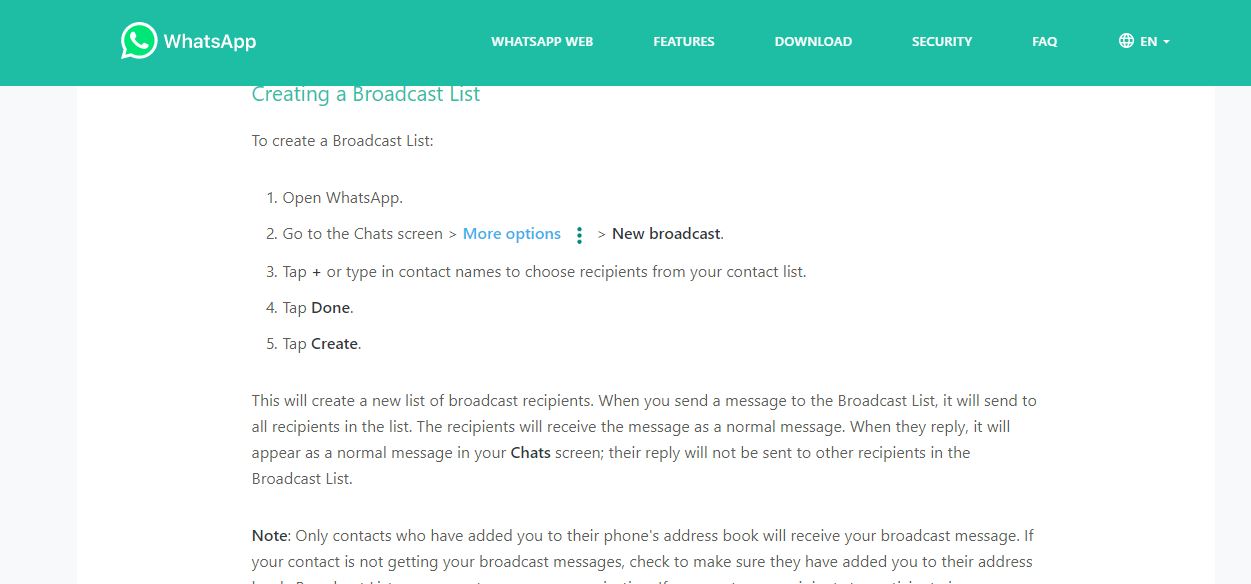
  • By using broadcasting feature whereby a single text/audio visual  message may be conveyed to a batch of people : The Boradcasting list may be created as below:
Image Source: WhatsApp

  • By forwarding the message to maximum five recipients at one time. Now, this “forwarding” may reach a wider recipient list if it is done in a group.  WhatsApp group can be created  by any individual by going to the chat tab and creating a new group. The image below may explain how groups can be created on WhatsApp:
Image source : WhatsApp

Interestingly, WhatsApp groups can be private or be public as well. Most of the groups who circulate images /contents of sexual abuse including  for self-gratification or group gratification, may keep their group private so that the group may not be disturbed by any 3rd party monitoring authority including the police. These group members generally may have a mutual understanding and trust whereby the contents shared by them would not be reported outside.  The members may necessarily download /save the sexual abuse/harassment videos/contents in their own devices  for individual gratification or for unethical gaining by further circulation as well. The end to end encryption by WhatsApp may make it more favorable for such group members to widely discuss and circulate such contents.

Public groups on the other hand are more open groups where people may join for discussions and it may not necessarily private for those whom the admin/s have invited or made them join. Unlike the private groups, public groups may be monitored if any  third party monitoring authority joins the discussion in disguise or any other group member decides to bring in the police or other monitoring stakeholders. In both these cases, admin’s responsibilities have been scrutinized by courts in India. The recent report suggests that the courts have held  responsible for allowing to spread seditious, inciting messages.[1]  WhatsApp group members and admins have also been booked for creating /circulating child sexual abuse materials for sexual gratification.[2]

  • What if the group admin is an underage user?

It is important to know the age barrier about WhatsApp users. There are infact not two, but three options given by WhatsApp. Lets check it:

  1. The minimum age criterion for European region including European Union countries is 16.
  2. For other countries the, the minimum age criteria is 13 unless the domestic laws of the said countries have fixed a higher age for using of WhatsApp.[3]
  3. Overlooking both, a child can use the WhatsApp services of the parents if the parent allows the child to use the services under his/her monitoring.

This in fact shows that a child may use WhatsApp, may create his/her own profile and may create contents him/herself for private or public sharing on WhatsApp with whoever he/she wants. 

  • What happens to the producer/distributor of the offensive contents?

In broader understanding, the child is legally permitted to create content  which he/she thinks can be circulated. Now, this has been a question for several courts : when a child is creating a sexting content and circulating the same with fellow children (including his/her boy/girl friend ),  how the courts (and the laws )would treat him/her ? Is he the perpetrator? Is he the victim? Or is he a ‘child’ with no liabilities?[4] S.67B of the Information technology Act, 2000(amended in 2008), Ss. 13 and 14 of the Protection of children from sexual offences Act, 2012 clearly mention that “whoever’ creates, circulates, produces etc  contents depicting children in sexually contents may be penalized. These cane be considered non-baliable, which would suggest that the punishment can be heavier.  Similarly, Ss. 67 and 67A of the Information Technology Act, 2000(amended in 2008) also penalizes ‘anyone’ who creates, distributes etc  sexually explicit and obscene materials. S. 354C of the Indian Penal Code also touches upon penalizing men who  private images of woman who would not consent for sharing such contents with third parties . S.375 and 376 of the Indian penal Code also touches upon capturing rape videos and storing or circulating the same. These offences can also be non-bailable and can have heavier punishments.

The contents that the children would have created also carries significance: if a child creates a sexting video or sexual abuse video or a non consensual porn image/content or  even a revenge porn content and sends it to his friend/s, the recipient may decide not to receive the content if from the look at the content or the text attached with it, the recipient feels that it should not be opened or should not be further circulated because it contains ‘bad stuff’.  WhatsApp is smart enough to have created limited policy guideline and security feature whereby one can report his/her child who may be using WhatsApp without parental guidance  and the parents feel that the child may be doing /victimized due to illegal /risky contents and connections.  It says

“If your underage child created a WhatsApp account, you can show them how to delete their account. You can learn how to delete an account in our Help Center.If you’d like to report an account belonging to someone underage, please send us an email. In your email, please provide the following documentation and redact or hide any unrelated personal information:

Proof of ownership of the WhatsApp number (e.g., copy of government-issued identification card and phone bill with the same name)

Proof of parental authority (e.g., copy of birth or adoption certificate for the underage child)

Proof of child’s date of birth (e.g., copy of birth or adoption certificate for the underage child)

We’ll promptly disable the WhatsApp account if it’s reasonably verifiable that the account belongs to your underage child. You won’t receive confirmation of this action. Our ability to review and take appropriate action on a report significantly improves with the completeness of the information requested above.[5]

Removal /deactivating of the said account is however at the discretion of WhatsApp especially when they would not be reasonably convinced .

But in case the reporting individual is not the parent of the child who may be doing illegal stuff  or who may be a potential victim, WhatsApp suggests to contact the parents of the child.

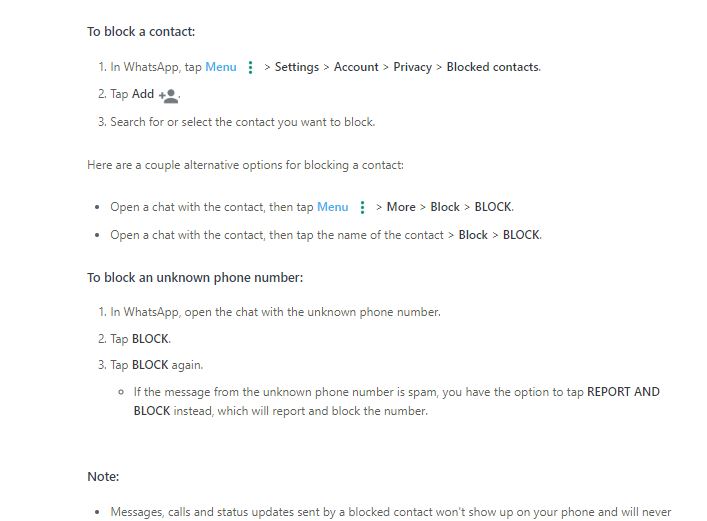
For adult wrong doers, WhatsApp has a typical formula which is followed by almost all social media companies : they would suggest to block the number so that the user of that particular number would not be able to contact the blocker  unless the earlier is being unblocked . Here is what WhatsApp suggests regarding how to block a number:

Image source : WhatsApp

  • The producer/distributor of the offensive content has been arrested. What about the offensive image?

The above information would not serve much purpose for blocking /reporting of the content unless the same is considered as an offending  subject through a police report. In such case, the said content may be made disabled from their own server, but they would rather work like email or SMS and would not access individual devices to dig out the offensive content to block and disable it. In such case, even if the persons (owning the WhatsApp numbers and profiles) may be blocked, the contents may keep on circulating unless these have been ‘ordered ‘ to be disabled from the server.  This is how the objectionable contents float from one device to another and reach out to millions after the original sender may have deleted from his device to save himself or he may have been arrested by the police.

Nothing but a police report about the said content therefore could be the best answer for blocking the content from being further circulated. But a few things can not be ignored when this is suggested: the police must act accordingly to make WhatsApp delete the content from its server and block the circulation whenever it appears on WhatsApp from which ever device. But this may become a herculean task especially when the police and the courts  may feel  challenged due to lack of infrastructure and proper laws. As long as this does not take place, WhatsApp users have to be responsible enough to not to circulate such contents even if they receive it from known or unknown numbers. Not to be forgotten, the police may arrest individuals who may store child sexual harassment videos /images unknowingly as well. But the unfortunate fact is this may not be the same for adult sexual abuse cases. But if the users use WhatsApp responsibly, the problem may definitely be address.

Please note : Do not violate copyright of this blog. If you would like to use information provided in this blog for your own assignment/writeup/project/blog/article, please cite it as “Halder D. (2019), ” WhatsApp reporting of women and child abuse videos:  The common understanding vs the reality”  29th April, 2019 , published in http://debaraticyberspace.blogspot.com


[1] See WhatsApp ‘admin’ spends five months in an Indian jail. Published in https://www.bbc.com/news/technology-44925166 Accessed on 22.04.2019

[2] See Sandhya Nair (2018) WhatsApp group sharing child porn busted, 5 held

Published in http://timesofindia.indiatimes.com/articleshow/65263327.cms?utm_source=contentofinterest&utm_medium=text&utm_campaign=cppst Accessed on 22.04.2019

[3] For more information see https://faq.whatsapp.com/en/general/26000151/?category=5245250

[4] Halder, D., & Jaishankar. (2013). Revenge Porn by Teens in the United

States and India: A Socio-legal Analysis. International Annals of

Criminology, 51(1-2), 85-111. ISSN: 00034452 (UGC Listed Journal)

[5] See https://faq.whatsapp.com/en/general/26000151/?category=5245250


[1] Cuthbertson Anthony (2019). WHATSAPP IS HOTBED FOR CHILD SEX ABUSE VIDEOS IN INDIA, STUDY FINDS. Published in https://www.independent.co.uk/life-style/gadgets-and-tech/news/whatsapp-child-sex-abuse-videos-groups-india-a8885811.html?fbclid=IwAR251ajPe20Y7zcXtD2o1s0w–86-Pr5UrKHVgv7IF_7swAH_dvEGQTzcZQ on 26th April, 2019. Retrieved on 26th April, 2019

[2] Halder, D., & Jaishankar, K. (2015). Harassment via WhatsApp in Urban

and Rural India: A Baseline Survey Report (2015). Tirunelveli, India:

Centre for Cyber Victim Counselling. Available @ https://www.cybervictims.org/CCVCresearchreport2015.pdf Retrieved on 27.04.2019

[3] Ibid

[4] See pp 2 in ibid

WhatsApp reporting of women and child abuse videos: The common understanding versus the reality

CYBER CRIME AGAINST WOMEN BY DEBARATI HALDER

Image credit : Google

Couple of days ago my friend shared an alarming news with me on Facebook about WhatsApp. It says that several cyber security think tanks including Cyber Peace Foundation are now finding out how WhatsApp groups are circulating child sexual abuse videos and how these contents are growing viral.[1] This is not an uncommon incident now. In 2015 from Centre for Cyber Victim Counselling, we had done an empirical research titled “Harassment via WhatsApp in Urban and Rural India: A Baseline Survey Report (2015).[2]This research was conducted in three cities namely Tirunelveli, Kolkata and Delhi with responders from the age group of 19-40. Even though this research did not include survey on WhatsApp groups , but it did emphasize on personal harassment or receiving of the sexually explicit images, harassing videos of others etc. Some of the findings of this report are as follows:
Ø32.8% stated that they are aware of the safety tools in WhatsApp and 42.7% said they feel it is safer than other internet communication services. 41.2% stated that they were not aware of the safety tools and 13.7% stated that they don’t feel that WhatsApp is safer than other internet communication services. 1.5% did not want to tell about their knowledge of awareness regarding safety tools in WhatsApp and 11.5% did not want to tell about their feelings whether WhatsApp is safer than other internet communication services. 24.4% stated that they have heard about the safety tools in WhatsApp but have no direct knowledge about it. 32.1% stated that they have heard about other internet communication services, but they do not have direct knowledge, whether WhatsApp is safer because they do not use other services.
ØIn answer to the question whether they had received any sexually explicit or obscene images including videos/images of rape, sexual abuse of women or children or men or LGBT people etc, among the 131 respondents, 11.5% stated that they had received sexually explicit or obscene images, 51.9% stated they did not receive such images and 2.3% did not want to answer. 34.4% stated that they are not aware of being targeted with such images because they do not use WhatsApp or have stopped using the services.[3]
This suggests that WhatsApp had been a “chosen platform” by predators since long.
 But why WhatsApp has become more dearer to predators than other social media websites like Facebook or Instagram especially for those including pedophiliacs or persons who  create and circulate abusive videos including sexual abuse videos of women  ?  Let’s have a reality check about WhatsApp here:
ØWhat is WhatsApp and how it works: As we had mentioned in the research report, WhatsApp messenger was started approximately in 2009 in the US by Jan Koumand Brian Action as a “better SMS alternative” (WhatsApp, 2014) and it is available for iPhone, Blackberry, Android, Windows phone, Nokia etc. This app uses the user’s phone number as the basic verification mode and it does not support calls via VoIP (Schrittwieser,Fr¨uhwirt, Kieseberg, Leithner, Mulazzani, Huber, & Weippl, 2014). Some of the basic features of WhatsApp include status update, profile picture update, uploading of address book (Schrittwieser, et. al., 2014), options to create/join groups (Terpstra, 2013), updates about location, uploading and circulating photos and videos and voice recordings. Typically WhatsApp verification may include a three stage procedure which involves (i) logging on to the download page of WhatsApp @ https://www.whatsapp.com/download/ and clicking on the chosen device icon and start downloading; (ii) the server then sends a 4-digit PIN number by SMS to the prospective user’s phone by SMS for verification and authentication (Schrittwieser, et. al., 2014), (iii) the user copies the code to the WhatsApp’s application graphical user interface (GUI) and after cross checking by the WhatsApp server the app gets activated on the phone of the user (Schrittwieser, et. al., 2014). Once connected with WhatsApp, the user can get the information about other WhatsApp users by simply checking his/her phone address book or call log history or Gmail address book. This is because WhatsApp may access the user’s contact list or address book to keep track of other mobile phone numbers who use the WhatsApp services and may store this information on the server (WhatsApp, 2014, see sub- para B in Para 3) to get people connected instantly, profile pictures of other users and one WhatsApp user may get instantly connected to others through the server.[4]
ØHow do users create network on WhatsApp and how the groups may be busted?
After downloading the app and activating the same, the user may get connected to his friends or like minded people by doing a simple search in his phone address book. Other numbers with WhatsApp applications may show up. Users may choose to circulate their messages in several ways through WhatsApp :
üBy using broadcasting feature whereby a single text/audio visual  message may be conveyed to a batch of people : The Boradcasting list may be created as below:
Image source : WhatsApp
üBy forwarding the message to maximum five recipients at one time. Now, this “forwarding” may reach a wider recipient list if it is done in a group.  WhatsApp group can be created  by any individual by going to the chat tab and creating a new group. 
Image source: WhatsApp
Interestingly, WhatsApp groups can be private or be public as well. Most of the groups who circulate images /contents of sexual abuse including  for self-gratification or group gratification, may keep their group private so that the group may not be disturbed by any 3rdparty monitoring authority including the police. These group members generally may have a mutual understanding and trust whereby the contents shared by them would not be reported outside.  The members may necessarily download /save the sexual abuse/harassment videos/contents in their own devices  for individual gratification or for unethical gaining by further circulation as well. The end to end encryption by WhatsApp may make it more favorable for such group members to widely discuss and circulate such contents.
Public groups on the other hand are more open groups where people may join for discussions and it may not necessarily private for those whom the admin/s have invited or made them join. Unlike the private groups, public groups may be monitored if any  third party monitoring authority joins the discussion in disguise or any other group member decides to bring in the police or other monitoring stakeholders. In both these cases, admin’s responsibilities have been scrutinized by courts in India. The recent report suggests that the courts have held  responsible for allowing to spread seditious, inciting messages.[5]  WhatsApp group members and admins have also been booked for creating /circulating child sexual abuse materials for sexual gratification.[6]
ØWhat if the group admin is an underage user?
It is important to know the age barrier about WhatsApp users. There are infact not two, but three options given by WhatsApp. Lets check it:
1.     The minimum age criterion for European region including European Union countries is 16.
2.     For other countries the, the minimum age criteria is 13 unless the domestic laws of the said countries have fixed a higher age for using of WhatsApp.[7]
3.     Overlooking both, a child can use the WhatsApp services of the parents if the parent allows the child to use the services under his/her monitoring.
This in fact shows that a child may use WhatsApp, may create his/her own profile and may create contents him/herself for private or public sharing on WhatsApp with whoever he/she wants. 
ØWhat happens to the producer/distributor of the offensive contents?
In broader understanding, the child is legally permitted to create content  which he/she thinks can be circulated. Now, this has been a question for several courts : when a child is creating a sexting content and circulating the same with fellow children (including his/her boy/girl friend ),  how the courts (and the laws )would treat him/her ? Is he the perpetrator? Is he the victim? Or is he a ‘child’ with no liabilities?[8] S.67B of the Information technology Act, 2000(amended in 2008), Ss. 13 and 14 of the Protection of children from sexual offences Act, 2012 clearly mention that “whoever’ creates, circulates, produces etc  contents depicting children in sexually contents may be penalized. These cane be considered non-baliable, which would suggest that the punishment can be heavier.  Similarly, Ss. 67 and 67A of the Information Technology Act, 2000(amended in 2008) also penalizes ‘anyone’ who creates, distributes etc  sexually explicit and obscene materials. S. 354C of the Indian Penal Code also touches upon penalizing men who  private images of woman who would not consent for sharing such contents with third parties . S.375 and 376 of the Indian penal Code also touches upon capturing rape videos and storing or circulating the same. These offences can also be non-bailable and can have heavier punishments.
The contents that the children would have created also carries significance: if a child creates a sexting video or sexual abuse video or a non consensual porn image/content or  even a revenge porn content and sends it to his friend/s, the recipient may decide not to receive the content if from the look at the content or the text attached with it, the recipient feels that it should not be opened or should not be further circulated because it contains ‘bad stuff’.  WhatsApp is smart enough to have created limited policy guideline and security feature whereby one can report his/her child who may be using WhatsApp without parental guidance  and the parents feel that the child may be doing /victimized due to illegal /risky contents and connections.  It says
“If your underage child created a WhatsApp account, you can show them how to delete their account. You can learn how to delete an account in our Help Center.If you\’d like to report an account belonging to someone underage, please send us an email. In your email, please provide the following documentation and redact or hide any unrelated personal information:
Proof of ownership of the WhatsApp number (e.g., copy of government-issued identification card and phone bill with the same name)
Proof of parental authority (e.g., copy of birth or adoption certificate for the underage child)
Proof of child\’s date of birth (e.g., copy of birth or adoption certificate for the underage child)
We\’ll promptly disable the WhatsApp account if it\’s reasonably verifiable that the account belongs to your underage child. You won\’t receive confirmation of this action. Our ability to review and take appropriate action on a report significantly improves with the completeness of the information requested above.[9]
Removal /deactivating of the said account is however at the discretion of WhatsApp especially when they would not be reasonably convinced .
But in case the reporting individual is not the parent of the child who may be doing illegal stuff  or who may be a potential victim, WhatsApp suggests to contact the parents of the child.
For adult wrong doers, WhatsApp has a typical formula which is followed by almost all social media companies : they would suggest to block the number so that the user of that particular number would not be able to contact the blocker  unless the earlier is being unblocked . Here is what WhatsApp suggests regarding how to block a number:
Image source: WhatsApp
ØThe producer/distributor of the offensive content has been arrested. What about the offensive image?
The above information would not serve much purpose for blocking /reporting of the content unless the same is considered as an offending  subject through a police report. In such case, the said content may be made disabled from their own server, but they would rather work like email or SMS and would not access individual devices to dig out the offensive content to block and disable it. In such case, even if the persons (owning the WhatsApp numbers and profiles) may be blocked, the contents may keep on circulatingunless these have been ‘ordered ‘ to be disabled from the server.  This is how the objectionable contents float from one device to another and reach out to millions after the original sender may have deleted from his device to save himself or he may have been arrested by the police.
Nothing but a police report or a court order about the said content therefore could be the best answer for blocking the content from being further circulated. But a few things can not be ignored when this is suggested: the police must act accordingly to make WhatsApp delete the content from its server and block the circulation whenever it appears on WhatsApp from which ever device. But this may become a herculean task especially when the police and the courts  may feel  challenged due to lack of infrastructure and proper laws. As long as this does not take place, WhatsApp users have to be responsible enough to not to circulate such contents even if they receive it from known or unknown numbers. Not to be forgotten, the police may arrest individuals who may store child sexual harassment videos /images unknowingly as well. But the unfortunate fact is this may not be the same for adult sexual abuse cases. But if the users use WhatsApp responsibly, the problem may definitely be address.

Please note : Do not violate copyright of this blog. If you would like to use information provided in this blog for your own assignment/writeup/project/blog/article, please cite it as “Halder D. (2019), \” WhatsApp reporting of women and child abuse videos:  The common understanding vs the reality”  29th April, 2019 , published in http://debaraticyberspace.blogspot.com


[1] Cuthbertson Anthony (2019). WHATSAPP IS HOTBED FOR CHILD SEX ABUSE VIDEOS IN INDIA, STUDY FINDS. Published in https://www.independent.co.uk/life-style/gadgets-and-tech/news/whatsapp-child-sex-abuse-videos-groups-india-a8885811.html?fbclid=IwAR251ajPe20Y7zcXtD2o1s0w–86-Pr5UrKHVgv7IF_7swAH_dvEGQTzcZQon 26th April, 2019. Retrieved on 26th April, 2019
[2] Halder, D., & Jaishankar, K. (2015). Harassment via WhatsApp in Urban
and Rural India: A Baseline Survey Report (2015). Tirunelveli, India:
Centre for Cyber Victim Counselling. Available @ https://www.cybervictims.org/CCVCresearchreport2015.pdfRetrieved on 27.04.2019
[3] Ibid
[4] See pp 2 in ibid
[5] See WhatsApp ‘admin’ spends five months in an Indian jail. Published in https://www.bbc.com/news/technology-44925166Accessed on 22.04.2019
[6] See Sandhya Nair (2018) WhatsApp group sharing child porn busted, 5 held
[8] Halder, D., & Jaishankar. (2013). Revenge Porn by Teens in the United
States and India: A Socio-legal Analysis. International Annals of
Criminology, 51(1-2), 85-111. ISSN: 00034452 (UGC Listed Journal)

The TikTok ban : Why the ban may fail to prevent online victimization of women

by Dr.Debarati Halder

Image credit: Google

On 24th April Madras High court would decide on the plea of Bytedance, which owns TikTok regarding the much talked about ban of the app. Tik Tok, , a nongaming app launched in 2019 has given a tough competition in regard to its popularity to all the social media giants because of the unique features  which allows users to create and share short videos with special effects. Teenagers and adults  in India loved the app because unlike other social media platforms including YouTube, TikTok has simple features to upload and publish videos. Unlike PubG however, this did not necessarily have gaming features.

In early April, 2019, the Madurai bench of Madras High court had in an interim order directed the government stakeholders in the State and Centre to ban the video app TikTok as the Public Interest Litigation in this regard emphasized that it encourages pornography and underage users are vulnerable to be exposed to sexually explicit contents, pornography etc, which may not be good for their mental and physical health.[1] Incidentally the Madurai Bench of the Madras High court was the first court in India to take suo motu cognizance in BlueWhale game case and asked the Central government and the social media website, web companies like Google etc to monitor what is being generated and catered to the users through their platform.[2] But in this case, the situation stands on a different platform: consequent to the interim order, Google and Apple removed TikTok app  from their Play Stores.  Resultant, Bytedance had incurred huge loss. But the later has now challenged this interim order on the ground that the interim order was passed on the basis of ex parte hearing. The company had stated that the app allows users to create videos and circulate them for fun and amusement and it does not pose any threat to security of individuals. Bytedance also stated that such bans are against right to speech and expression.[3]

We can see here two important points:

First : before the governments took prohibitory actions (like what happened for PubG ban in Gujarat, where police started arresting those who downloaded and played PubG even after the ban order was conveyed to the public)[4], Web company like Google  and phone and software manufacturing company Apple had followed the mandates of S.79 (exemption of liability of intermediary in certain cases) and Rule 3 of  Information technology (Intermediaries guidelines) Rule, 2011 : specially mentionable are Rules 3(3) and 3(4) which states as follows:

Rule 3(3) states that The intermediary shall not knowingly host or publish any information or shall not initiate the transmission, select the receiver of transmission, and select or modify the information contained in the transmission as specified in sub-rule (2): provided that the following actions by an intermediary shall not amount to hosing, publishing, editing or storing of any such information as specified in sub-rule: (2) — (a) temporary or transient or intermediate storage of information automatically within the computer resource as an intrinsic feature of such computer resource, involving no exercise of any human editorial control, for onward transmission or communication to another computer resource; (b) removal of access to any information, data or communication link by an intermediary after such information, data or communication link comes to the actual knowledge of a person authorised by the intermediary pursuant to any order or direction as per the provisions of the Act;

And Rule 3(4) of the above rule states The intermediary, on whose computer system the information is stored or hosted or published, upon obtaining knowledge by itself or been brought to actual knowledge by an affected person in writing or through email signed with electronic signature about any such information as mentioned in sub-rule (2) above, shall act within thirty six hours and where applicable, work with user or owner of such information to disable such information that is in contravention of sub-rule (2). Further the intermediary shall preserve such information and associated records for at least ninety days for investigation purposes.

These companies apparently did not want to invite any more troubles like the past when they were repeatedly called by the court to explain why they had not taken any action to block and ban contents and materials victimizing children which are regularly shared through their platforms.

Second: Bytedance, the parent company of TikTok has alleged that they were not heard by the court before pronouncing the ban order. Apparently, they may become the first web company to stress upon the point as why they should be banned when they have their flagging system and they do take care of the contents that are flagged. This case would make a history in India where the court has taken a decision influenced by the happenings of the past, and the concerned web company promises to break the glass ceiling because they know this is not the end. While many information as how to use (activate/download) TikTok without Google/Apple Play stores have started surfacing on internet,[5] my concern is not how the app may or may not be downloaded legally or illegally.

Exposing children to pornography, using women as items of sexual gratification, grooming, creating “dangerous contents” which may cause damage to public health, online victimization of women and children etc would not stop if one video creating and sharing app is banned. In that case, the courts must also consider picking up social media giants Facebook, Twitter, YouTube, Instagram etc, and search engines like Google for banning them because of their constant failure to monitor misogynist, sexist, child abusive contents. All social media companies including YouTube have data mined several images, contents and marked them as adult specific. Several videos are not available unless the users verify their age. But how will you search the needle in the hey stack? The courts could not yet make strict regulations for virtual age verification by the web companies. The web companies (hosted in US and other countries) are confused about the law relating to pornography because India does not have any focused law defining pornography still now. Further, the web companies also do not accept all contents (which are alleged to be porn as per Indian understanding) as offensive because the ever expanding free speech and expression jurisprudence of the US does not allow the web companies to take down the contents unless it is gravely threatening to the physical and virtual privacy  and security of the person concerned or damages the reputation of the woman (in case the victim is a woman). Children can still be exposed to online dangers through Facebook, Instagram or YouTube. Women are continued to be victimized through all pockets of internet.

As such, there may be practically no solution for this and ban would encourage more law breaking. Google and Apple had already shown that they are willing to follow the local laws (or rather, not to fall in any legal tangles regarding web service providers liability). It is expected that India creates focused laws to address different emerging and existing types of online victimization and the same are implemented in proper way. Otherwise, the orders of banning may lead to ground ZERO.


[1] For more, see J.Sam Daniel (2019). Ban TikTok, Its encouraging pornography : Madras High court to Centre. Published in NDTV on April 4, 2019. URL https://www.ndtv.com/india-news/madras-high-court-directs-centre-to-prohibit-downloading-of-tik-tok-app-2017482 Accessed on 12.04.2019

[2] Halder, D.(2018) The #Bluewhale challenge to the Indian judiciary: A

critical analysis of the response of the Indian higher judiciary to risky

online contents with special reference to Bluewhale Suicide game. In

Sourdin Tania & Zariski Archie (eds.), The responsive judges. USA:Springer  ISBN no. 978-981-13-1022-5  pp 259-276.

[3] See  Live law news network (2019). TikTok Ban : SC Says Ban Will Stand Lifted If Madras HC Fails To Decide On Interim Order By April 24. Available @https://www.livelaw.in/top-stories/tiktok-ban-sc-says-ban-will-stand-lifted-if-madras-hc-fails-to-decide-on-interim-order-by-april-24-144438 . Publshed in on 22nd April, 2019.  Accessed on 23rd April, 2019

[4] See Ahaskar Abhijit (2019). Why playing PUBG Mobile can get you arrested in Gujarat. Published in https://www.livemint.com/news/india/why-playing-pubg-mobile-can-get-you-arrested-in-gujarat-1552849965539.html on 18th March, 2019. Accessed on 12.04.2019

[5] For example, see SC hearing on TikTok: Why it is difficult to ban the app in India. Published in https://www.businesstoday.in/technology/internet/tiktok-ban-after-madras-hc-decision-reality-banned-apps-tiktok-pubg/story/339286.html   on April 22, 2019. Accessed on 22.04.2019

Weekly news Update: April 15-22, 2019

Why TikTok and Pubgibans are being heavily criticised in india ?
https://www.firstpost.com/india/tiktok-and-pubg-bans-in-india-is-it-even-constitutional-strong-regulations-needed-over-arbitrary-measures-to-address-issue-6489331.html

Facebook fails the privacy setup again and this time its the email contacts of the users. It shows how data mining can be done due to the privacy lacunas of the service providers
https://www.firstpost.com/india/tiktok-and-pubg-bans-in-india-is-it-even-constitutional-strong-regulations-needed-over-arbitrary-measures-to-address-issue-6489331.html

New Jersy man hacks into private cloud based accounts of two women, takes over sexually explicit contents without consent and shares it on publicly accissible sites; court sentences 5 years prison sentence for 2nd degree computer theft https://www.nj.gov/oag/newsreleases19/pr20190418a.html

The TikTok ban : Why the ban may fail to prevent online victimization of women

CYBER CRIME AGAINST WOMEN BY DEBARATI HALDER

Image credit: Google 

On 24th April Madras High court would decide on the plea of Bytedance, which owns TikTok regarding the much talked about ban of the app. Tik Tok, , a nongaming app launched in 2019 has given a tough competition in regard to its popularity to all the social media giants because of the unique features  which allows users to create and share short videos with special effects. Teenagers and adults  in India loved the app because unlike other social media platforms including YouTube, TikTok has simple features to upload and publish videos. Unlike PubG however, this did not necessarily have gaming features.
In early April, 2019, the Madurai bench of Madras High court had in an interim order directed the government stakeholders in the State and Centre to ban the video app TikTok as the Public Interest Litigation in this regard emphasized that it encourages pornography and underage users are vulnerable to be exposed to sexually explicit contents, pornography etc, which may not be good for their mental and physical health.[1] Incidentally the Madurai Bench of the Madras High court was the first court in India to take suo motu cognizance in BlueWhale game case and asked the Central government and the social media website, web companies like Google etc to monitor what is being generated and catered to the users through their platform.[2]But in this case, the situation stands on a different platform: consequent to the interim order, Google and Apple removed TikTok app  from their Play Stores.  Resultant, Bytedance had incurred huge loss. But the later has now challenged this interim order on the ground that the interim order was passed on the basis of ex parte hearing. The company had stated that the app allows users to create videos and circulate them for fun and amusement and it does not pose any threat to security of individuals. Bytedance also stated that such bans are against right to speech and expression.[3]
We can see here two important points:
First : before the governments took prohibitory actions (like what happened for PubG ban in Gujarat, where police started arresting those who downloaded and played PubG even after the ban order was conveyed to the public)[4], Web company like Google  and phone and software manufacturing company Apple had followed the mandates of S.79 (exemption of liability of intermediary in certain cases) and Rule 3 of  Information technology (Intermediaries guidelines) Rule, 2011 : specially mentionable are Rules 3(3) and 3(4) which states as follows:
Rule 3(3) states that The intermediary shall not knowingly host or publish any information or shall not initiate the transmission, select the receiver of transmission, and select or modify the information contained in the transmission as specified in sub-rule (2): provided that the following actions by an intermediary shall not amount to hosing, publishing, editing or storing of any such information as specified in sub-rule: (2) — (a) temporary or transient or intermediate storage of information automatically within the computer resource as an intrinsic feature of such computer resource, involving no exercise of any human editorial control, for onward transmission or communication to another computer resource; (b) removal of access to any information, data or communication link by an intermediary after such information, data or communication link comes to the actual knowledge of a person authorised by the intermediary pursuant to any order or direction as per the provisions of the Act;
And Rule 3(4) of the above rule states The intermediary, on whose computer system the information is stored or hosted or published, upon obtaining knowledge by itself or been brought to actual knowledge by an affected person in writing or through email signed with electronic signature about any such information as mentioned in sub-rule (2) above, shall act within thirty six hours and where applicable, work with user or owner of such information to disable such information that is in contravention of sub-rule (2). Further the intermediary shall preserve such information and associated records for at least ninety days for investigation purposes.
These companies apparently did not want to invite any more troubles like the past when they were repeatedly called by the court to explain why they had not taken any action to block and ban contents and materials victimizing children which are regularly shared through their platforms.
Second: Bytedance, the parent company of TikTok has alleged that they were not heard by the court before pronouncing the ban order. Apparently, they may become the first web company to stress upon the point as why they should be banned when they have their flagging system and they do take care of the contents that are flagged. This case would make a history in India where the court has taken a decision influenced by the happenings of the past, and the concerned web company promises to break the glass ceiling because they know this is not the end. While many information as how to use (activate/download) TikTok without Google/Apple Play stores have started surfacing on internet,[5] my concern is not how the app may or may not be downloaded legally or illegally.
Exposing children to pornography, using women as items of sexual gratification, grooming, creating “dangerous contents” which may cause damage to public health, online victimization of women and children etc would not stop if one video creating and sharing app is banned. In that case, the courts must also consider picking up social media giants Facebook, Twitter, YouTube, Instagram etc, and search engines like Google for banning them because of their constant failure to monitor misogynist, sexist, child abusive contents. All social media companies including YouTube have data mined several images, contents and marked them as adult specific. Several videos are not available unless the users verify their age. But how will you search the needle in the hey stack? The courts could not yet make strict regulations for virtual age verification by the web companies. The web companies (hosted in US and other countries) are confused about the law relating to pornography because India does not have any focused law defining pornography still now. Further, the web companies also do not accept all contents (which are alleged to be porn as per Indian understanding) as offensive because the ever expanding free speech and expression jurisprudence of the US does not allow the web companies to take down the contents unless it is gravely threatening to the physical and virtual privacy  and security of the person concerned or damages the reputation of the woman (in case the victim is a woman). Children can still be exposed to online dangers through Facebook, Instagram or YouTube. Women are continued to be victimized through all pockets of internet.
As such, there may be practically no solution for this and ban would encourage more law breaking. Google and Apple had already shown that they are willing to follow the local laws (or rather, not to fall in any legal tangles regarding web service providers liability). It is expected that India creates focused laws to address different emerging and existing types of online victimization and the same are implemented in proper way. Otherwise, the orders of banning may lead to ground ZERO.
Please note : Do not violate copyright of this blog. If you would like to use information provided in this blog for your own assignment/writeup/project/blog/article, please cite it as “Halder D. (2019), \”The TikTok ban : Why it may fail to prevent online victimization of women”  23rd April, 2019 , published in http://debaraticyberspace.blogspot.com


[1] For more, see J.Sam Daniel (2019). Ban TikTok, Its encouraging pornography : Madras High court to Centre. Published in NDTV on April 4, 2019. URL https://www.ndtv.com/india-news/madras-high-court-directs-centre-to-prohibit-downloading-of-tik-tok-app-2017482Accessed on 12.04.2019
[2] Halder, D.(2018) The #Bluewhale challenge to the Indian judiciary: A
critical analysis of the response of the Indian higher judiciary to risky
online contents with special reference to Bluewhale Suicide game. In
Sourdin Tania & Zariski Archie (eds.), The responsive judges. USA:Springer  ISBN no. 978-981-13-1022-5  pp 259-276.
[3] See  Live law news network (2019). TikTok Ban : SC Says Ban Will Stand Lifted If Madras HC Fails To Decide On Interim Order By April 24. Available @https://www.livelaw.in/top-stories/tiktok-ban-sc-says-ban-will-stand-lifted-if-madras-hc-fails-to-decide-on-interim-order-by-april-24-144438 . Publshed in on 22nd April, 2019.  Accessed on 23rd April, 2019
[4] See Ahaskar Abhijit (2019). Why playing PUBG Mobile can get you arrested in Gujarat. Published in https://www.livemint.com/news/india/why-playing-pubg-mobile-can-get-you-arrested-in-gujarat-1552849965539.htmlon 18th March, 2019. Accessed on 12.04.2019
[5] For example, see SC hearing on TikTok: Why it is difficult to ban the app in India. Published in https://www.businesstoday.in/technology/internet/tiktok-ban-after-madras-hc-decision-reality-banned-apps-tiktok-pubg/story/339286.html   on April 22, 2019. Accessed on 22.04.2019

Gender and Internet: Webmagazine for cyber law for women Weekly News update 8th April-14th April

Trolls did not leave the woman scientist who worked for Blackhole image

https://www.theverge.com/2019/4/13/18308652/katie-bouman-black-hole-science-internet?fbclid=IwAR2-nMULZyjZbiyf41xlHJKFIWAQpr5oM0VD9cH2tqH-ChMUH1IJAzlzKjg

Egypt’s new ‘Facebook law’ targets freedom of speech

https://www.bbc.com/news/world-middle-east-44858547

Jullian Assange, founder of Wikileaks, gets arrested in UK on charges of unauthirsed access to government documents, computer network , computer system etc.

https://www.washingtonpost.com/world/europe/wikileakss-julian-assange-evicted-from-ecuador-embassy-in-london/2019/04/11/1bd87b58-8f5f-11e8-ae59-01880eac5f1d_story.html?utm_term=.82aa3e8d4e88

Concept of “Cyber space”

By Dr.Debarati Halder, LL.B., M.L., Ph.D(Law) (NLSIU)

Image curtsy: Google

The modern human society is overly dependent on the internet now. Artificial intelligence and Internet of things (IOT)   have made it possible for machines to work and speak for humans. In other words, human minds are now ‘colonized’ by machines which compel most  human beings to think, act and text what  they (the machines) want the later to do. While this statement may be considered as ‘dramatic’. The fact is, the machines are controlled by human intelligence. This human intelligence (which  controls the machines) is developed by few skilled people who may have developed the software, the hardware and may have done the entire designing of machines for the benefit of human society.  This human intelligence is the main factor which empowers the machines to control the thought process, activities and execution of the thought process of many other human beings.

 Let us understand this process through the following diagram :

A fine example of this could be using automatic washing machines.  Almost every households have washing machines and many of them are automatic. This auto mechanism is the first box : humans  make software and user-friendly hardware  understanding the needs of fellow human beings. Next , the machines get adjusted to human needs. No, it’s not about befriending humans; it’s about how the machine decides how much clothes should be washed /dried on a daily /weekly basis, what should be the water temperature and how best that temperature may suite the clothes. Next, humans get dependent on the machine, its artificial intelligence and its ability. The manual work time that should have been  done by the humans, is now taken over by the machine. The humans now can use this time for more positive (and in several cases negative too) productive works. The psychology of human beings then becomes completely connected with the machines and dependent on the machines.  At one point of time, when the machine stops working or does not perform according to the expected performance level of humans, the later becomes angry, irritated, annoyed.  What we see here is  the connection between human psychology and artificial intelligence.  This is a unique connection between physical space and mental space, which is bridged by something called cyber space.  Let us understand the typology of space here:

Physical space is that space for which laws may be made for governing behaviors, contracts, marriages, succession, criminal and civil liabilities etc.  Traditionally laws are made for controlling those incidences which can be felt physically, financially and to a certain extent psychologically. Consider Penal laws meant for governing criminal activities like causing grievous physical harm. Law is made to address pre execution plan, execution of the plan and post execution impact on the body, mind and society as a whole. It is for this reason that we get to see the application of law meant for abetment, motive, means rea, commission of offence, compensation, punishment of the offender  and also rehabilitation of the offender as well as the victim. 

Mental space on the other hand, is  a logical and formal abstract space where ideas may generate. Laws may be created for governing outer behavior of individuals. But mental space may not be governed by any law. It has to be disciplined to think create action plans as per the positive societal norms. A good example of law versus mental space can be, a plan to commit a theft is made in the mind. Until and unless this is executed and committed in the physical space, it can not be prosecuted or laws can not be used to regulate that particular act. This means that planning or thinking something in mind  and doing the same on physical space are two different things. Unless both are connected by plan and consequent action and execution of the plan, laws may not be applied.

Cyber space on the other hand, is a  virtual space where machines are made to work at the command given by humans. Laws are necessary to govern this space because it executes several plans or motives, makes contracts and creates criminalities and civil liabilities too. however, there is a common overlapping of the concepts of cyber space and internet.

On 1st April,2019, Gmail celebrated its 15th birthday. This free email service by Google rapidly became popular across the globe and threw a tough competition to other email services including Hotmail, Yahoo mail, AOL mail etc. These are also known as web mail services. They are termed as Web mail services because unlike postal mail services, these web mail services connect people through cyber space, which, to many is popularly known as Worldwideweb.

But technically speaking, the concept of cyber space evolved much more earlier than the concept of Worldwideweb. The abstract concept of “Cyber space” was created first by a novelist and science fiction writer William Gibson in his novel  “Neuromancer”. He described the cyber space as ““A graphic representation of data abstracted from banks of every computer in the human system. Unthinkable complexity. Lines of light ranged in the nonspace of the mind, clusters and constellations of data. Like city lights, receding.”[1]

The term cyberspace is actually derived from the term cybernetics (which comes from the Greek term kybernētikḗ [2]) which was  coined by Norbert Weiner in 1948. Weiner explained it as “scientific study of control and communication of animal and machine”. [3]

As one can see, the description of cyber space by Gibson not only threw light on the complexities of computer technologies, but also emphasized on involvement of human mind in operating on this space. In 1989 Tim Bernes Lee invented WorldWideWeb, which is an information space. This made the documents and other web resources easily available on the web space.

Image created by Dr.Debarati Halder

 But this does not mean that  WorldWideWeb or cyber space is only machine oriented. As Gibson emphasized, cyber space (and later WorldWideWeb) is necessarily controlled by human beings. Cyber Space has been used positively as well as negatively  to create documents, interconnect military departments with universities for security research purposes, for networking, creating and providing huge data base for several types of information. At the same time, cyber space is also used for several criminalities, for plotting terror, for carrying out terror activities and for executing criminal activities targeting governments, corporate houses and individuals .  with the emergence of  internet, new information and digital communication technologies cyber space has now become the most chosen space for  carrying out criminalities against individuals including women and children.

Lawrence Lessig, a fine academician and a Harvard professor addressed cyber space from the perspective of governing cyber space. According to him, the concept of cyber space can be explained on the basis of the followings[1]:

  • Cyber space is a livable place.
  • It has Possibility of actions
  • It has its own Time organization mechanism
  • It has Spatial organization
  • It has distinctive  four pillars of cyber space (law, norms, market, constraint)
  • Cyber space is regulable.

Jaishankar Karuppannan, the Father of Cyber Criminology also added one more basic feature of cyber space, which is connected with human psychology; he said people behave differently when they move from one space to another and this ‘space’ is none other than the cyber space.[2]

The UK Cyber Security Strategy Protecting and promoting the UK in a digital world however defined the concept of cyber space from cyber security aspect.[3] According them,

  • Cyberspace is an interactive domain made up of digital networks that is used to store, modify and communicate information.
  • It includes the internet, but also the other information systems that support our businesses, infrastructure and services. Digital networks already underpin the supply of electricity and water to our homes, help organise the delivery of food and other goods to shops, and act as an essential tool for businesses across the UK.
  • And their reach is increasing as we connect our TVs, games consoles, and even domestic appliances

According to National Military Strategy for Cyberspace Operations, a classified document, the Joint Chiefs of Staff, US, 2006, “Cyber space is a domain characterized by the use of electronics and the electromagnetic spectrum to store, modifies and exchange data via networked systems and associated physical infrastructures.”[4]

According to National Cyber Security Policy, India , 2013, Cyberspace is a complex environment consisting of interactions between people, software and services, supported by worldwide distribution of information and communication technology (ICT) devices and networks.[5]

The latest definition of cyber space could be found in the definition developed by Marco Mayer, Luigi Martino, Pablo Mazurier and Gergana Tzvetkova in their 2014 paper on how to define cyber space .[6] Their definition runs as follows:

“Cyberspace is a global and dynamic domain (subject to constant change) characterized by the combined use of electrons and the electromagnetic spectrum, whose purpose is to create, store, modify, exchange, share, and extract, use, eliminate information and disrupt physical resources. Cyberspace includes:

 a) Physical infrastructures and telecommunications devices that allow for the connection of technological and communication system networks, understood in the broadest sense (SCADA devices, smartphones/tablets, computers, servers, etc.);

 b) Computer systems (see point a) and the related (sometimes embedded) software that guarantee the domain’s basic operational functioning and connectivity;

 c) Networks between computer systems;

d) Networks of networks that connect computer systems (the distinction between networks and networks of networks is mainly organizational);

 e) The access nodes of users and intermediaries routing nodes;

 f) Constituent data (or resident data). Often, in common parlance (and sometimes in commercial language), networks of networks are called the Internet (with a lowercase i), while networks between computers are called intranet. Internet (with a capital I, in journalistic language sometimes called the Net) can be considered a part of the system a).

 A distinctive and constitutive feature of cyberspace is that no central entity exercises control over all the networks that make up this new domain.”

All these definitions however skirt around the concept of cyber space as developed by Lessig.

Hence, cyber space may be explained as below:


Cyber space therefore is a holistic concept of abstract space which is inclusive of computer devices that are enabled to communicate with other computers, computer networks, storage spaces that may be enabled to import and export data , communication platforms, memory and memory chips etc. Cyber space necessarily includes infrastructure, information super highway, webpages etc  which facilitates information and data  exchange as well.


[1] Lessig Lawrence. The Laws of cyber space. https://cyber.harvard.edu/works/lessig/laws_cyberspace.pdf. 1998

[2] Jaishankar Karuppannan. Space transition theory. “Crimes of the Internet” edited by Frank Schmalleger & Michael Pittaro, published by Prentice Hall (2008: 283-301).

[3] See https://assets.publishing.service.gov.uk/government/uploads/system/uploads/attachment_data/file/60961/uk-cyber-security-strategy-final.pdf

[4] https://www.hsdl.org/?view&did=35693

[5] Retrieved from http://datia.nic.in/doc/cyber.pdf

[6] Definition by Marco Mayer, Luigi Martino, Pablo Mazurier and Gergana Tzvetkova, Draft Pisa, 19 May 2014 https://www.academia.edu/7096442/How_would_you_define_Cyberspace